
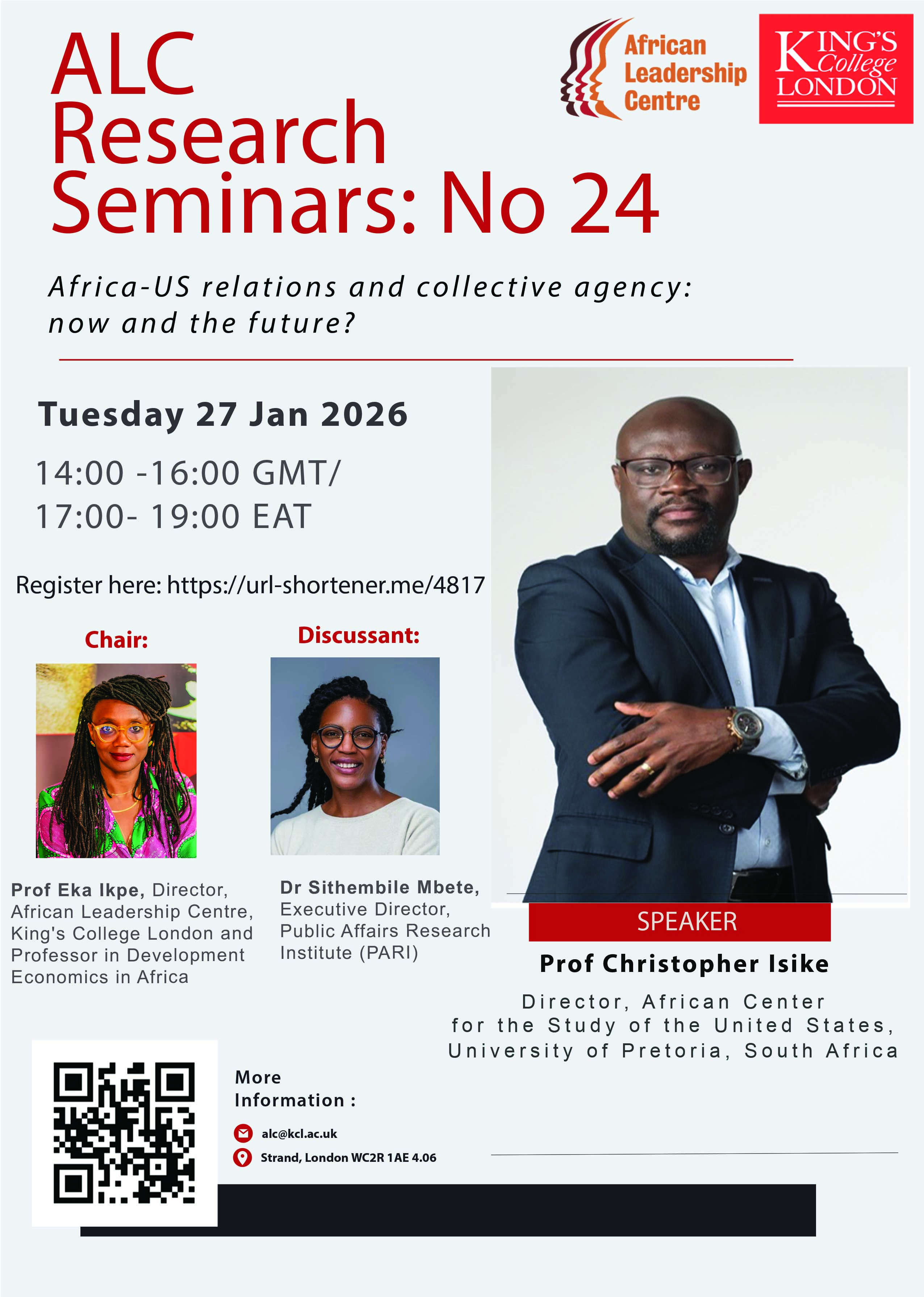
The African Leadership Centre (ALC), in collaboration with the Cluster of Research Excellence on Interdisciplinary Peace, are pleased to invite you to the ALC Research seminar series event “Africa-US relations and collective agency: now and the future?” which will be held on Tuesday, 27 January 2026, at 14:00 -16:00 GMT/17:00- 19:00 EAT.
The session will examine how Prof. Isike’s research on group hegemony and foreign relations in Nigeria and South Africa, along with his leadership at the African Centre for the Study of the Americas, can shed light on current US–Africa relations and the importance of a collective, Pan-African perspective.
Abstract
Africa-US relations are at a critical juncture. While US policy discourse increasingly acknowledges Africa as a “partner of choice” in a multipolar world, Africa’s ability to shape the terms of engagement remains uneven and weak.
This presentation shall analyse Africa-United States relations through the lens of group hegemonic leadership, a theoretical perspective that moves beyond individual state power to examine how coalitions, institutions, and norm-setting capacities enable collective influence in global politics. Rather than treating Africa as a passive arena of US engagement or as a fragmented set of bilateral partners, the presentation conceptualises Africa as a potential group hegemon, able to exercise leadership through coordinated agenda-setting, institutional authority, and normative power with the continent. In so doing, the presentation shall focus on how collective leadership can emerge through shared vision, institutional coherence, and the capacity to provide regional and global public goods. It shall explore four areas: trade and industrial policy, security cooperation, critical minerals and technology governance to assess whether Africa is exercising leadership or reacting to US priorities. The argument is that where Africa speaks and acts collectively, it enhances bargaining power and normative influence; where fragmentation persists, engagement remains transactional and asymmetrical. Therefore, the future of Africa–US relations will hinge less on US strategic intent than on Africa’s ability to consolidate group hegemonic leadership – transforming numerical strength and moral authority into coordinated power capable of shaping rules, partnerships, and global outcomes.
Venues:
Virtual – ZOOM
Speaker:
Prof Christopher Isike, Director, African Center for the Study of the United States, University of Pretoria, South Africa.
Discussant:
Dr Sithembile Mbete, Executive Director, Public Affairs Research Institute (PARI).
Chair:
Professor Eka Ikpe, Director, African Leadership Centre, King’s College London and Professor in Development Economics in Africa.