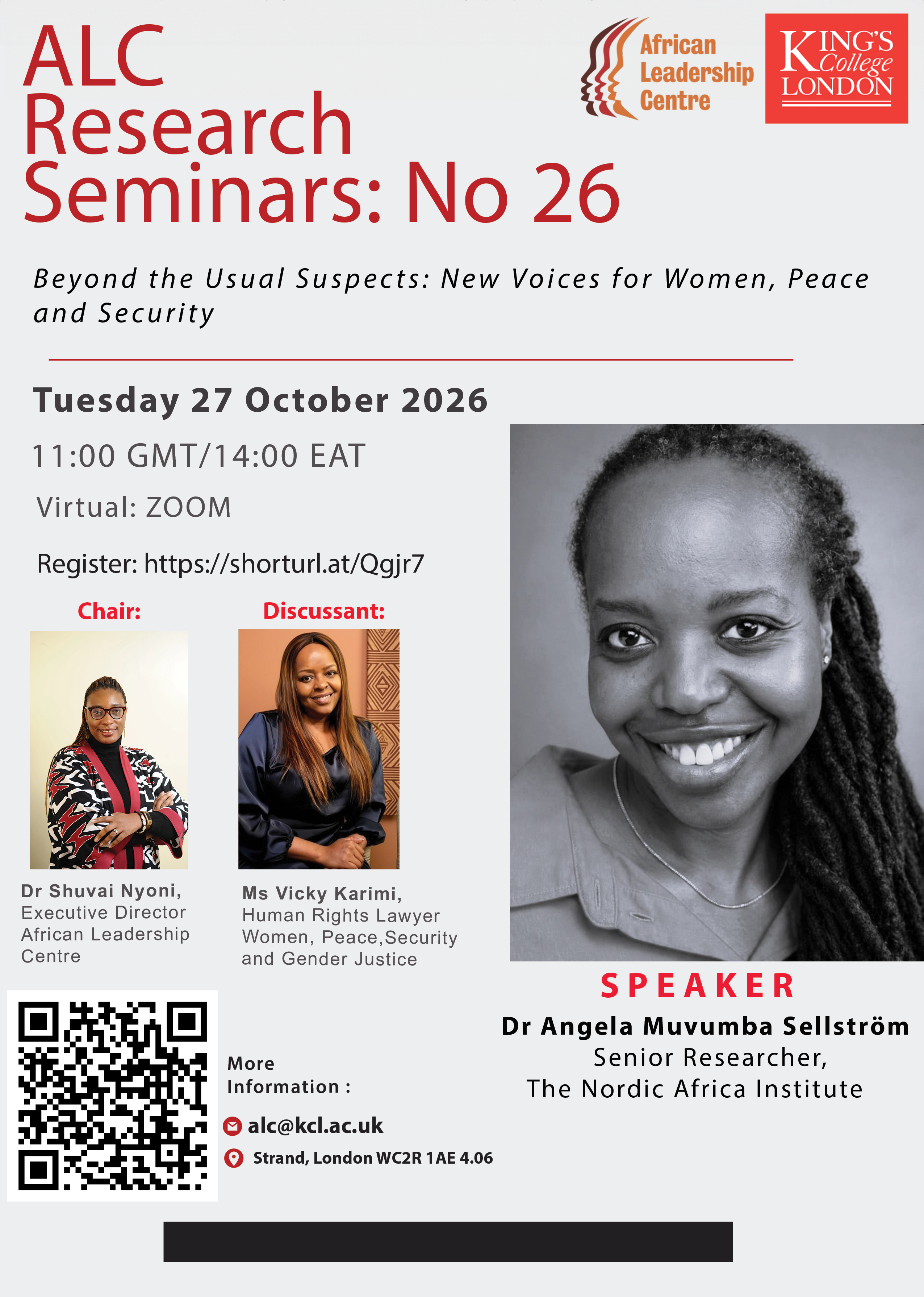
BEGIN:VCALENDAR
VERSION:2.0
PRODID:-//CiviCRM//NONSGML CiviEvent iCal//EN
X-WR-TIMEZONE:Europe/London
METHOD:PUBLISH
BEGIN:VTIMEZONE
TZID:Europe/London
BEGIN:STANDARD
TZOFFSETFROM:+0000
TZOFFSETTO:+0000
TZNAME:GMT
DTSTART:20261027T110000
END:STANDARD
END:VTIMEZONE
BEGIN:VEVENT
UID:CiviCRM_EventID_34_a2bc4f5368ad2c002b2010a5a489b3b9@alcoffice.systems
SUMMARY:ALC Research Seminar No 26: Beyond the Usual Suspe
 cts: New Voices for Women\, Peace and Security
X-ALT-DESC;FMTTYPE=text/html:<!DOCTYPE HTML PUBLIC
  "-//W3C//DTD HTML 3.2//EN"><html><body><p style="
 text-align:justify"><img alt="" src="https://alcof
 fice.systems/wp-content/uploads/civicrm/persist/co
 ntribute/images/RS%2026%20Final.png" style="width:
  650px\;" /></p>\n \n <hr />\n <p style="text-alig
 n:justify\; margin-bottom:11px"><span style="font-
 size:12pt"><span style="line-height:115%"><span st
 yle="font-family:Aptos\,sans-serif"><a href="http:
 //email.alcafricanos.com/c/eJwkzTFuxCAQQNHTQGkxAzZ
 QUESKuMdkPKxRsL0B70q5fWSl-83XW1MpAZ3TksBbiOhmh3pLy
 zrPKwdijNYjSCD3NePiZPERFiO6JjToACCAMdHghJYB2ITorC0
 eg3KGGlPplek4x8Tnrlvarus5lP1QmBVmanyWUlmm8Tsu2YfCz
 PVdue8K80611eOhML96uwebX8p-QpwVLj91vdtDcF73dDZq8k3
 HRPWgm_53m9AqfWz1yXJcXaazP_Q74V8AAAD__3puSkg" styl
 e="color:#467886\; text-decoration:underline" targ
 et="_blank"><span style="font-family:&quot\;Times 
 New Roman&quot\;\,serif">The African Leadership Ce
 ntre</span></a><span lang="en-KE" style="font-fami
 ly:&quot\;Times New Roman&quot\;\,serif">&nbsp\;(A
 LC)\, is pleased to invite you to the ALC&nbsp\;Re
 search&nbsp\;seminar series event titled &ldquo\;<
 b>Beyond the Usual Suspects: New Voices for Women\
 , Peace and Security&rdquo\;</b> happening on Tues
 day\, <b>27 October 2026</b>\, from <b>11:00 AM GM
 T/14:00 EAT.</b></span></span></span></span></p>\n
  \n <p style="text-align:justify\; margin-bottom:1
 1px"><span style="font-size:12pt"><span style="lin
 e-height:115%"><span style="font-family:Aptos\,san
 s-serif"><b><span lang="en-KE" style="font-family:
 &quot\;Times New Roman&quot\;\,serif"><span style=
 "color:#c00000">Abstract</span></span></b></span><
 /span></span></p>\n \n <p style="text-align:justif
 y\; margin-bottom:11px"><span style="font-size:12p
 t"><span style="line-height:115%"><span style="fon
 t-family:Aptos\,sans-serif"><span lang="en-KE" sty
 le="font-family:&quot\;Times New Roman&quot\;\,ser
 if">This Research seminar examines why the UN Wome
 n\, Peace and Security agenda must move beyond its
  established community of policymakers\, gender ex
 perts and activists&mdash\;the agenda&rsquo\;s &ld
 quo\;usual suspects&rdquo\;&mdash\;and become a br
 oader societal movement.&nbsp\; Over the past 25 y
 ears\, the WPS agenda has increased recognition of
  women&rsquo\;s roles in conflict prevention and p
 eacebuilding\, strengthened accountability for con
 flict-related sexual violence\, and established ge
 nder as an important analytical tool in internatio
 nal peace and security. However\, implementation r
 emains slow\, top-down and insufficiently connecte
 d to the people and institutions that influence ev
 eryday attitudes\, behaviour and security. The lec
 ture will briefly examine the WPS agenda&rsquo\;s 
 African roots and the substantial role of African 
 states\, regional institutions and civil-society o
 rganisations in its development. </span></span></s
 pan></span></p>\n \n <p style="text-align:justify\
 ; margin-bottom:11px"><span style="font-size:12pt"
 ><span style="line-height:115%"><span style="font-
 family:Aptos\,sans-serif"><span lang="en-KE" style
 ="font-family:&quot\;Times New Roman&quot\;\,serif
 ">It will then consider why formal mechanisms&mdas
 h\;including national action plans\, mediation net
 works\, gender advisers and gender focal points&md
 ash\;have not yet generated sufficiently broad or 
 transformative change. The central argument is tha
 t WPS must engage &ldquo\;everyday influencers&rdq
 uo\;: people whose professional\, cultural\, relig
 ious or social authority allows them to shape atti
 tudes and practices at community level. These incl
 ude teachers\, youth mentors\, police officers\, j
 udges\, health workers\, artists\, musicians\, soc
 ial-media influencers\, religious leaders\, tradit
 ional leaders and customary authorities.</span></s
 pan></span></span></p>\n \n <p style="text-align:j
 ustify\; margin-bottom:11px"><span style="font-siz
 e:12pt"><span style="line-height:115%"><span style
 ="font-family:Aptos\,sans-serif"><b><span lang="en
 -KE" style="font-family:&quot\;Times New Roman&quo
 t\;\,serif"><span style="color:#c00000">Venue:</sp
 an></span></b></span></span></span></p>\n \n <p st
 yle="text-align:justify\; margin-bottom:11px"><spa
 n style="font-size:12pt"><span style="line-height:
 115%"><span style="font-family:Aptos\,sans-serif">
 <span lang="en-KE" style="font-family:&quot\;Times
  New Roman&quot\;\,serif">Virtual- Zoom</span></sp
 an></span></span></p>\n \n <p style="text-align:ju
 stify\; margin-bottom:11px"><span style="font-size
 :12pt"><span style="line-height:115%"><span style=
 "font-family:Aptos\,sans-serif"><b><span lang="en-
 KE" style="font-family:&quot\;Times New Roman&quot
 \;\,serif"><span style="color:#c00000">Speaker:</s
 pan></span></b> </span></span></span></p>\n \n <p 
 style="text-align:justify\; margin-bottom:11px"><s
 pan style="font-size:12pt"><span style="line-heigh
 t:115%"><span style="font-family:Aptos\,sans-serif
 "><b><span lang="en-KE" style="font-family:&quot\;
 Times New Roman&quot\;\,serif">Dr Angela Muvumba S
 ellstr&ouml\;m\, </span></b><span lang="en-KE" sty
 le="font-family:&quot\;Times New Roman&quot\;\,ser
 if"><span style="color:black">Senior Researcher\, 
 The Nordic Africa Institute (NAI).</span></span></
 span></span></span></p>\n \n <p style="text-align:
 justify\; margin-bottom:11px"><span style="font-si
 ze:12pt"><span style="line-height:115%"><span styl
 e="font-family:Aptos\,sans-serif"><span lang="EN-U
 S" style="font-family:&quot\;Times New Roman&quot\
 ;\,serif">Dr Angela Muvumba Sellstr&ouml\;m&rsquo\
 ;s work focuses on the determinants of Africa&rsqu
 o\;s security policies and the gendered dimensions
  of conflict and peace processes. She is Senior Re
 searcher at the Nordic Africa Institute (NAI). Wit
 h over 25 years of experience\, she has led multiy
 ear projects on sexual violence and armed groups&r
 squo\; wartime behaviour\, and the role of elected
  members of the UN Security Council. She is curren
 tly exploring how global governance and geopolitic
 al competition shape peace and security dynamics.&
 nbsp\; </span></span></span></span></p>\n \n <p st
 yle="text-align:justify\; margin-bottom:11px"><spa
 n style="font-size:12pt"><span style="line-height:
 115%"><span style="font-family:Aptos\,sans-serif">
 <span lang="EN-US" style="font-family:&quot\;Times
  New Roman&quot\;\,serif">Dr Muvumba Sellstr&ouml\
 ;m is also a Visiting Researcher at Uppsala Univer
 sity&rsquo\;s Department of Peace and Conflict Res
 earch\, Vice President of the Board of Directors o
 f the Life and Peace Institute (LPI)\, a Non-resid
 ent Fellow at the International Peace Institute (I
 PI)\, an Associate Senior Researcher of the Stockh
 olm International Peace Research Institute (SIPRI)
 .&nbsp\;&nbsp\; </span></span></span></span></p>\n
  \n <p style="text-align:justify\; margin-bottom:1
 1px"><span style="font-size:12pt"><span style="lin
 e-height:115%"><span style="font-family:Aptos\,san
 s-serif"><b><span lang="EN-US" style="font-family:
 &quot\;Times New Roman&quot\;\,serif">SUBJECT EXPE
 RTISE</span></b></span></span></span></p>\n \n <p 
 style="text-align:justify\; margin-bottom:11px"><s
 pan style="font-size:12pt"><span style="line-heigh
 t:115%"><span style="font-family:Aptos\,sans-serif
 "><span lang="EN-US" style="font-family:&quot\;Tim
 es New Roman&quot\;\,serif">UN Security Council\; 
 non-permanent members of the Security Council\; Af
 rican Union (AU)\; women\, peace and security (WPS
 ) agenda\; conflict-related sexual violence\; Arme
 d actors\; conflict mediation\; amnesties.</span><
 /span></span></span></p>\n \n <p style="text-align
 :justify\; margin-bottom:11px"><span style="font-s
 ize:12pt"><span style="line-height:115%"><span sty
 le="font-family:Aptos\,sans-serif"><span lang="EN-
 US" style="font-family:&quot\;Times New Roman&quot
 \;\,serif">REGIONAL EXPERTISE</span></span></span>
 </span></p>\n \n <p style="text-align:justify\; ma
 rgin-bottom:11px"><span style="font-size:12pt"><sp
 an style="line-height:115%"><span style="font-fami
 ly:Aptos\,sans-serif"><span lang="EN-US" style="fo
 nt-family:&quot\;Times New Roman&quot\;\,serif">Af
 rica\, Great Lakes\; South Africa. </span></span><
 /span></span></p>\n \n <p style="text-align:justif
 y\; margin-bottom:11px"><span style="font-size:12p
 t"><span style="line-height:115%"><span style="fon
 t-family:Aptos\,sans-serif"><b><span lang="en-KE" 
 style="font-family:&quot\;Times New Roman&quot\;\,
 serif"><span style="color:#c00000">Discussant: </s
 pan></span></b></span></span></span></p>\n \n <p s
 tyle="text-align:justify\; margin-bottom:11px"><sp
 an style="font-size:12pt"><span style="line-height
 :115%"><span style="font-family:Aptos\,sans-serif"
 ><b><span lang="EN-US" style="font-family:&quot\;T
 imes New Roman&quot\;\,serif">Ms. Vicky Karimi</sp
 an></b></span></span></span></p>\n \n <p style="te
 xt-align:justify\; margin-bottom:11px"><span style
 ="font-size:12pt"><span style="line-height:115%"><
 span style="font-family:Aptos\,sans-serif"><span l
 ang="en-KE" style="font-family:&quot\;Times New Ro
 man&quot\;\,serif">Vicky Karimi<b> </b>is a human 
 rights lawyer with expertise in Women\, Peace and 
 Security and Gender Justice. She has considerable 
 experience in legal and policy work and has worked
  on gender equality\, constitution-making\, develo
 pment of legal frameworks and human rights issues 
 in Kenya\, Liberia\, Northern Uganda\, Sudan\, Sou
 th Sudan and Sierra Leone among other countries. V
 icky has a demonstrated commitment to gender equal
 ity\, good governance\, constitutionalism\, democr
 acy and human rights. She is an alumnus of the Wom
 en\, Peace and Security Fellowship of the African 
 Leadership Centre/King&rsquo\;s College\, London (
 2009/2010).</span></span></span></span></p>\n \n <
 p style="text-align:justify\; margin-bottom:11px">
 <span style="font-size:12pt"><span style="line-hei
 ght:115%"><span style="font-family:Aptos\,sans-ser
 if"><b><span lang="en-KE" style="font-family:&quot
 \;Times New Roman&quot\;\,serif"><span style="colo
 r:#c00000">Chair:</span></span></b> </span></span>
 </span></p>\n \n <p style="text-align:justify\; ma
 rgin-bottom:11px"><span style="font-size:12pt"><sp
 an style="line-height:115%"><span style="font-fami
 ly:Aptos\,sans-serif"><b><span lang="en-KE" style=
 "font-family:&quot\;Times New Roman&quot\;\,serif"
 ><span style="color:black">Dr Shuvai Nyoni\, </spa
 n></span></b><span lang="en-KE" style="font-family
 :&quot\;Times New Roman&quot\;\,serif"><span style
 ="color:black">Executive Director\, African Leader
 ship Centre</span></span></span></span></span></p>
 \n \n <hr />\n <p>&nbsp\;</p></body></html>
DESCRIPTION:\n \n \n \n \n The African Leadership Centre (ALC)
 \, is pleased to invite you to the ALC Research se
 minar series event titled “Beyond the Usual Suspec
 ts: New Voices for Women\, Peace and Security” hap
 pening on Tuesday\, 27 October 2026\, from 11:00 A
 M GMT/14:00 EAT.\n \n \n \n Abstract\n \n \n \n Th
 is Research seminar examines why the UN Women\, Pe
 ace and Security agenda must move beyond its estab
 lished community of policymakers\, gender experts 
 and activists—the agenda’s “usual suspects”—and be
 come a broader societal movement.  Over the past 2
 5 years\, the WPS agenda has increased recognition
  of women’s roles in conflict prevention and peace
 building\, strengthened accountability for conflic
 t-related sexual violence\, and established gender
  as an important analytical tool in international 
 peace and security. However\, implementation remai
 ns slow\, top-down and insufficiently connected to
  the people and institutions that influence everyd
 ay attitudes\, behaviour and security. The lecture
  will briefly examine the WPS agenda’s African roo
 ts and the substantial role of African states\, re
 gional institutions and civil-society organisation
 s in its development. \n \n \n \n It will then con
 sider why formal mechanisms—including national act
 ion plans\, mediation networks\, gender advisers a
 nd gender focal points—have not yet generated suff
 iciently broad or transformative change. The centr
 al argument is that WPS must engage “everyday infl
 uencers”: people whose professional\, cultural\, r
 eligious or social authority allows them to shape 
 attitudes and practices at community level. These 
 include teachers\, youth mentors\, police officers
 \, judges\, health workers\, artists\, musicians\,
  social-media influencers\, religious leaders\, tr
 aditional leaders and customary authorities.\n \n 
 \n \n Venue:\n \n \n \n Virtual- Zoom\n \n \n \n S
 peaker: \n \n \n \n Dr Angela Muvumba Sellström\, 
 Senior Researcher\, The Nordic Africa Institute (N
 AI).\n \n \n \n Dr Angela Muvumba Sellström’s work
  focuses on the determinants of Africa’s security 
 policies and the gendered dimensions of conflict a
 nd peace processes. She is Senior Researcher at th
 e Nordic Africa Institute (NAI). With over 25 year
 s of experience\, she has led multiyear projects o
 n sexual violence and armed groups’ wartime behavi
 our\, and the role of elected members of the UN Se
 curity Council. She is currently exploring how glo
 bal governance and geopolitical competition shape 
 peace and security dynamics.  \n \n \n \n Dr Muvum
 ba Sellström is also a Visiting Researcher at Upps
 ala University’s Department of Peace and Conflict 
 Research\, Vice President of the Board of Director
 s of the Life and Peace Institute (LPI)\, a Non-re
 sident Fellow at the International Peace Institute
  (IPI)\, an Associate Senior Researcher of the Sto
 ckholm International Peace Research Institute (SIP
 RI).   \n \n \n \n SUBJECT EXPERTISE\n \n \n \n UN
  Security Council\; non-permanent members of the S
 ecurity Council\; African Union (AU)\; women\, pea
 ce and security (WPS) agenda\; conflict-related se
 xual violence\; Armed actors\; conflict mediation\
 ; amnesties.\n \n \n \n REGIONAL EXPERTISE\n \n \n
  \n Africa\, Great Lakes\; South Africa. \n \n \n 
 \n Discussant: \n \n \n \n Ms. Vicky Karimi\n \n \
 n \n Vicky Karimi is a human rights lawyer with ex
 pertise in Women\, Peace and Security and Gender J
 ustice. She has considerable experience in legal a
 nd policy work and has worked on gender equality\,
  constitution-making\, development of legal framew
 orks and human rights issues in Kenya\, Liberia\, 
 Northern Uganda\, Sudan\, South Sudan and Sierra L
 eone among other countries. Vicky has a demonstrat
 ed commitment to gender equality\, good governance
 \, constitutionalism\, democracy and human rights.
  She is an alumnus of the Women\, Peace and Securi
 ty Fellowship of the African Leadership Centre/Kin
 g’s College\, London (2009/2010).\n \n \n \n Chair
 : \n \n \n \n Dr Shuvai Nyoni\, Executive Director
 \, African Leadership Centre\n \n \n \n \n  \n \n 
CATEGORIES:Conference
CALSCALE:GREGORIAN
DTSTAMP;TZID=Europe/London:20261027T110000
DTSTART;TZID=Europe/London:20261027T110000
DTEND;TZID=Europe/London:20261027T110000
URL:https://alcoffice.systems/civicrm/event/info/?reset=1&id=34
END:VEVENT
END:VCALENDAR
